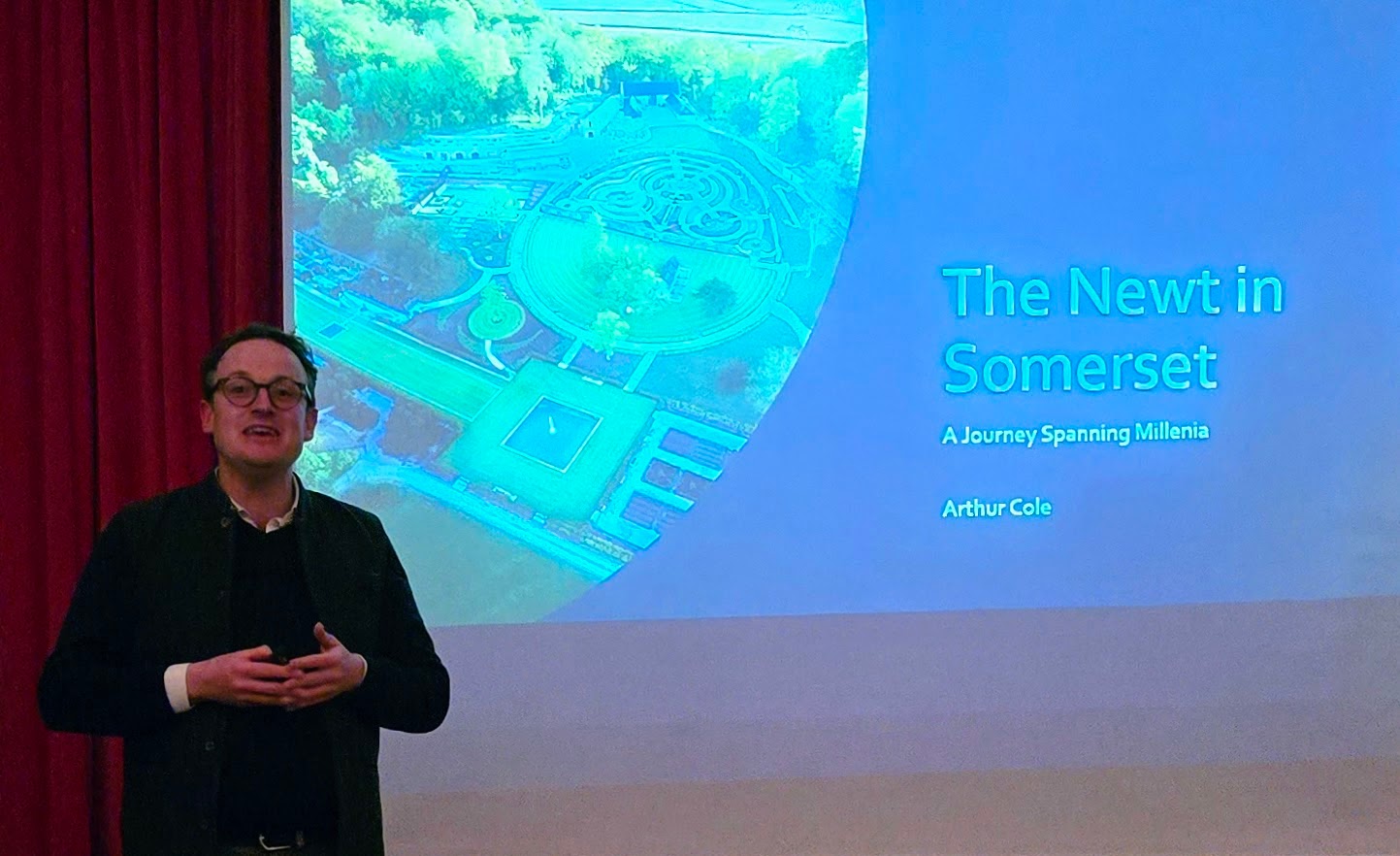

For our November meeting of the Gardening Club, the speaker was Arthur Cole and he was talking about ‘The Newt’ with reference to its present form being the latest step on a journey which has lasted several millennia in broad terms and three centuries with specific reference to the gardens within the estate.
In the eighteenth century the original farmhouse at Hadspen was moulded into the ‘perfect gentleman’s seat’ by a succession of prosperous Bristol merchants and lawyers and its grounds acquired fountains, tree-lined avenues and a ha-ha. From 1785 the estate was owned by the Hobhouse family and in the 1880s Margaret Hobhouse began to develop the garden in a naturalistic style. Following a later period of neglect the famous garden designer, Penelope Hobhouse made her first garden here in the 1960s. Subsequently, in the 1980s and 1990s, Nori and Sandra Pope created their famous ‘Colour Gardens’ in the parabola-shaped walled garden. The most recent and most dramatic change occurred in 2013 when the 800-acre estate was purchased by a South African couple who decided to spend a shed-load of money and create something unique. There are many amazing features at ‘The Newt’ including a Roman villa, acres of finely trained apple trees, glorious ice-creams and, last but not least, a gathering of spitting toads or, as they are known to some younger people, squirty frogs!
Mr Cole spoke well and after a few technical teething problems showed some lovely photographs of white cattle and expensive cyder. He also managed to make reference to one of P.G. Wodehouse’s more memorable character creations, the ardent newt-lover, Gussie Fink-Nottle. What Gussie did not know about the mating habits of these salamanders was simply not worth knowing!
But, to return to the popular fallacy that Lydford is a cultural desert, Mr.Cole also asked the audience to consider a few aspects of Roman and Greek mythology. No T.V. Soap operas, reality show celebrities or computer games referenced here but proper, solid and upstanding classical learning. Amongst the pantheon of Greek deities was a fairly rustic and minor god of fertility named Priapus. He developed such a following that the Romans adopted him and he became especially noted for his popularity amongst gardeners. Further details of this chap can be accessed from the well-thumbed multi-volume copy of the Encyclopaedia Britannica that sits on the shelves of the front room or alternatively any informative website might be consulted.
And finally, January 13th 2026 is when it all starts again. Membership fees, a snip at £20, will be payable at the first meeting of the year.